Tin foil remains a familiar phrase, although modern food packaging usually uses aluminium foil. The name stayed behind.
Industry expert Matt Meenan of The Aluminum Association explains the distinction plainly: “What people call tin foil today is generally aluminum foil.” This detail matters because aluminium offers a useful balance of strength, flexibility, and low weight. A thin sheet can wrap a sandwich tightly, cover a baking dish, or protect chocolate from light. It can also slow oxygen, moisture, and odor transfer when sealed correctly.
The material works through a simple physical barrier. Its bright surface reflects heat and light, while its tightly formed sheet limits contact with air. Folded edges create a closer seal around food. A lunch container can stay cleaner, and roasted vegetables can retain moisture more effectively. Still, tin foil is not a complete preservation system. It does not replace refrigeration, safe cooking temperatures, or careful storage.
There is another practical advantage. Aluminium foil can be recycled in many communities when it is clean and sufficiently large. A greasy, crumpled scrap may be rejected, however. That limitation is easy to overlook. Packaging decisions are rarely perfect.
Some foods also require caution. Highly acidic or salty ingredients may react with bare aluminium during long storage. Tomatoes, citrus marinades, and heavily salted dishes deserve extra attention. A coated product, glass container, or manufacturer’s guidance may be more suitable. Understanding these trade-offs explains why tin foil remains widely used, but not universally ideal, for food packaging.
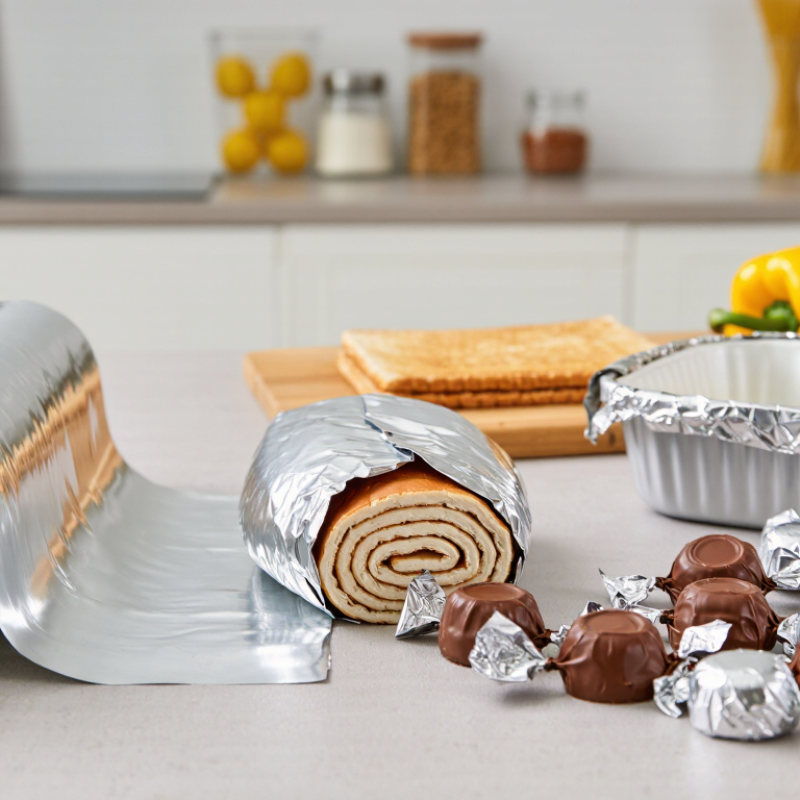
The phrase “tin foil” is common, but modern kitchen foil is usually made from aluminum. True tin foil was thinner, heavier, and more likely to leave a metallic taste. Aluminum replaced it because aluminum is lighter, easier to roll, and more economical for large-scale packaging. The name survived, even when the material changed. That detail is easy to miss.
Aluminum foil protects food from light, moisture, oxygen, and outside odors. A folded sheet can cover a warm dish, wrap a sandwich, or separate frozen portions. Its smooth surface also transfers heat quickly, which helps food warm more evenly in an oven.
Yet foil is not a perfect barrier in every situation. Sharp bones can puncture it, and repeated folding creates weak lines. I have seen a clean-looking wrap leak after one careless crease.
Highly acidic or salty foods may react with exposed aluminum during long storage. Tomatoes, citrus marinades, and heavily salted dishes deserve extra care. Use a suitable container for extended contact, especially when refrigeration lasts several days. Foil can also be recycled in some areas, but it should be clean and free from food residue. Local recycling rules differ. Calling it “tin foil” is understandable, but checking the actual material leads to better packaging decisions.
Why Is Tin Foil Used for Food Packaging?
Aluminum foil is widely used because it creates a strong barrier around food. It blocks light, oxygen, moisture, and many outside odors. These properties help protect flavor, texture, and freshness during storage. The material is also lightweight and easy to fold around uneven foods. A tight fold can reduce air exposure around leftovers, sliced fruit, or baked meals.
Heat moves through foil quickly and evenly. This makes it useful for covering dishes during cooking or keeping food warm briefly. However, foil does not preserve food by itself. Safe temperatures, clean handling, and suitable storage time still matter. Foil can also tear easily when stretched over sharp bones or rough edges. That small weakness is easy to overlook. Its performance depends on careful use.
Tips: Press the foil gently against the food container, but avoid crushing delicate items. Use a fresh sheet when wrapping strongly flavored foods. Acidic or salty foods may react with bare aluminum during long storage, especially when moisture is present. In those cases, use a suitable food-safe liner or container. Do not rely on foil to replace refrigeration. Check for holes before storing food, since even a tiny opening can expose it to air. Foil is recyclable in many areas, but clean, dry material is usually required. Local collection rules can differ.
| Property | Typical Value or Characteristic | Packaging Benefit | Practical Consideration |
|---|---|---|---|
| Material Composition | Modern “tin foil” is generally aluminum foil, made primarily from aluminum alloy. | Provides a lightweight, strong, and formable packaging material. | The term “tin foil” is commonly used informally, although modern food foil is not usually made from tin. |
| Light Barrier | Opaque when intact; blocks virtually all visible light. | Helps protect light-sensitive foods, fats, vitamins, and beverages from photodegradation. | Performance can be reduced by tears, pinholes, transparent coatings, or incomplete coverage. |
| Moisture Barrier | Essentially impermeable to water vapor when pinhole-free. | Helps prevent drying, moisture uptake, texture changes, and freezer burn. | Creases and microscopic pinholes may reduce the barrier, especially in very thin foil. |
| Oxygen and Aroma Barrier | Very high barrier to oxygen and many volatile aroma compounds when intact. | Helps slow oxidation, rancidity, aroma loss, and contamination from external odors. | In flexible packaging, foil is often laminated with paper or plastic to improve sealing and durability. |
| Light Reflectivity | Aluminum surfaces can reflect more than 90% of incident radiant energy, depending on finish and wavelength. | Reduces absorption of radiant heat and helps protect contents from light exposure. | Reflectivity varies with surface finish, oxidation, coating, and the wavelength of radiation. |
| Thermal Conductivity | Pure aluminum has a thermal conductivity of approximately 237 W/m·K at room temperature. | Promotes rapid and relatively even heat transfer during cooking, chilling, and freezing. | Foil transfers heat quickly; it does not provide strong insulation by itself. |
| Temperature Resistance | Aluminum melts at approximately 660°C (1,220°F). | Suitable for many common cooking, baking, freezing, and food-heating applications. | Actual use limits depend on foil thickness, coating, contact with food, and the appliance. It should not contact exposed heating elements. |
| Typical Thickness | Food-packaging foil is commonly produced from about 6 to 200 micrometers; household foil is often around 10 to 20 micrometers. | Thin gauges reduce material use while maintaining useful barrier and wrapping performance. | Thinner foil is lighter but is more susceptible to tearing, punctures, and pinholes. |
| Formability | Can be folded, wrapped, pressed, and shaped without specialized equipment. | Conforms closely to food shapes and helps create compact packages with minimal empty space. | Sharp edges and repeated folding can damage the foil or cause small tears. |
| Dead-Fold Behavior | Retains a fold or crease after being shaped. | Helps keep wraps closed and maintains the package shape around irregular foods. | Foil usually requires a fold, crimp, adhesive, or heat-sealable laminate rather than relying on elastic recovery. |
| Weight Efficiency | Aluminum density is approximately 2.70 g/cm³, lower than many common metals. | Offers strong barrier performance with relatively low package weight. | Overall package weight also depends on thickness, coatings, laminates, and closures. |
| Hygiene and Protection | The foil surface is nonporous and can protect food from light, moisture, air, and external contamination. | Supports food quality and helps maintain cleanliness during storage and transport. | Foil must be clean and properly handled; it does not replace safe food storage temperatures or hygiene practices. |
| Chemical Compatibility | Generally suitable for many dry, neutral, and low-acid foods. | Works effectively for everyday wrapping, baking, freezing, and short-term food storage. | Uncoated aluminum may react with highly acidic or salty foods, so coated or laminated packaging is preferred for extended contact. |
| Recyclability | Aluminum can be recycled repeatedly without losing its basic material properties. | Recycling can conserve energy and reduce the need for primary aluminum production. | Recycling availability varies by local collection systems; heavily food-soiled foil may not be accepted unless cleaned. |
Note: Values are typical material characteristics. Actual performance depends on alloy, foil thickness, surface finish, coatings, laminates, package design, and storage conditions.
Why Is Tin Foil Used for Food Packaging?
How Foil Protects Food from Light, Air, Moisture, and Odors
Tin foil is commonly called aluminum foil, and its value comes from its barrier performance. A tightly formed foil layer blocks nearly all light, helping protect oils, spices, and dairy products from light-driven oxidation. It also limits oxygen exchange, which can slow rancid flavors and color changes. The Flexible Packaging Association identifies barrier protection as a key function in modern food packaging.
Moisture control matters too. A foil wrap can reduce water vapor movement, helping biscuits stay crisp and frozen foods resist surface dehydration. It also limits odor transfer. Strong-smelling foods remain more contained, while outside odors are less likely to enter. The effect is practical: a wrapped meal may still smell fresh when opened hours later. Food waste remains a serious concern. The FAO’s State of Food and Agriculture report estimated that 14% of food is lost between harvest and retail, making protection during storage and transport important.
Foil is not magic. Tiny pinholes, sharp folds, or poor seals can weaken its barrier. One small flaw matters. Packaging engineers often test oxygen and water-vapor transmission under controlled conditions, because real kitchens are less predictable. The UNEP Food Waste Index Report 2024 estimated that 1.05 billion tonnes of food were wasted in 2022. That figure does not prove foil is always the answer, but it supports careful packaging choices based on food type, storage time, and handling conditions.
Intact aluminum foil provides an almost complete barrier to visible light and very strong protection against oxygen, water vapor, and odor transfer. Its performance depends on foil thickness, pinholes, folds, seals, and package damage. The ratings shown are indicative barrier-effectiveness values on a 0–100 scale, where higher values mean stronger protection.
“Tin foil” usually means aluminum foil, valued for its barrier properties and flexibility. It blocks light, air, moisture, and many odors. This helps protect food during short-term storage, baking, roasting, and transport. A tightly folded sheet can cover a bowl of leftovers or keep roasted vegetables warm for a limited time. Its thin structure also fits around sandwiches, bread, and irregular food portions.
Suitable applications depend on the food and storage period. Foil works well for dry snacks, baked goods, and prepared meals that need brief refrigeration. It is less suitable for long contact with highly acidic or salty foods, such as tomato sauce or heavily seasoned marinades. These foods may react with the metal surface and affect flavor. Use a food-contact material and avoid wrapping food in torn or heavily creased foil. I once assumed a tight wrap was always safer, but trapped heat can encourage quality loss.
Tips: Leave space around hot food so steam can escape. Cool leftovers promptly before covering them. Do not use foil in a microwave unless the appliance instructions specifically allow it. For freezing, press foil closely against the food and add a second protective layer to reduce moisture loss. Label the package with the storage date. Small details matter.
Although people call it tin foil, most household wrap is aluminium foil. It blocks light, oxygen, moisture, and odors. That barrier protects food during baking, chilling, and short-term storage. In my kitchen experience, foil also handles heat better than many thin plastic films. It shapes tightly around a tray, leaving fewer exposed edges.
Safety depends on the food. Acidic or salty ingredients, such as tomatoes, citrus, and marinades, may increase aluminium transfer. The European Food Safety Authority advises limiting unnecessary aluminium exposure from food-contact materials. Foil should not touch strongly acidic foods for long periods. It also should not replace proper refrigeration. A sealed surface cannot stop bacterial growth. This is an easy detail to overlook.
Recycling offers a strong environmental benefit, but used foil is often rejected when greasy or too small. The International Aluminium Institute reports that recycled aluminium requires about 5% of the energy used for primary aluminium production. Clean foil can therefore retain valuable material. Yet recycling systems differ by location, and the headline number does not guarantee local recovery.
Tips: Scrape off food, combine small pieces into one ball, and check local recycling rules. Avoid microwaves unless the appliance instructions specifically permit foil. Reuse clean foil when practical, but discard foil with heavy food residue. Safety advice is not always universal. Local guidance matters.