China has become a major sourcing base for wrapping foil, serving food, pharmaceutical, household, and industrial packaging markets. Its factories range from high-volume aluminum foil mills to specialized converters producing printed, embossed, and laminated materials.
Market reports show sustained demand. Grand View Research estimated the global aluminum foil market at approximately USD 24 billion in 2023, with continued growth expected through 2030. Mordor Intelligence also forecasts expansion, although its figures differ because it uses different market boundaries. These differences matter. Buyers should not compare reports blindly.
Guido Aufdemkamp, former Executive Director of the European Aluminium Foil Association, stated, “Aluminium foil is a permanent material. It can be recycled over and over again without losing its properties.” This point supports foil’s long service history, but recycling performance still depends on collection systems and local infrastructure.
This guide examines ten Chinese wrapping foil manufacturers for global buyers. The selection considers production capacity, alloy options, thickness control, surface quality, export experience, certifications, and customer support. Factory verification remains essential. A polished website is not proof of stable production.
Look closely at the details. Ask for recent inspection records, sample rolls, technical data sheets, and batch traceability. Confirm whether quoted capacity covers usable output or only installed machinery. Some supplier claims may appear impressive, yet remain difficult to verify.
The ranking is therefore practical, not absolute. Prices change. Lead times shift. Quality may vary between batches. Buyers should treat this list as a starting point for disciplined supplier evaluation, not as a substitute for independent audits and testing.
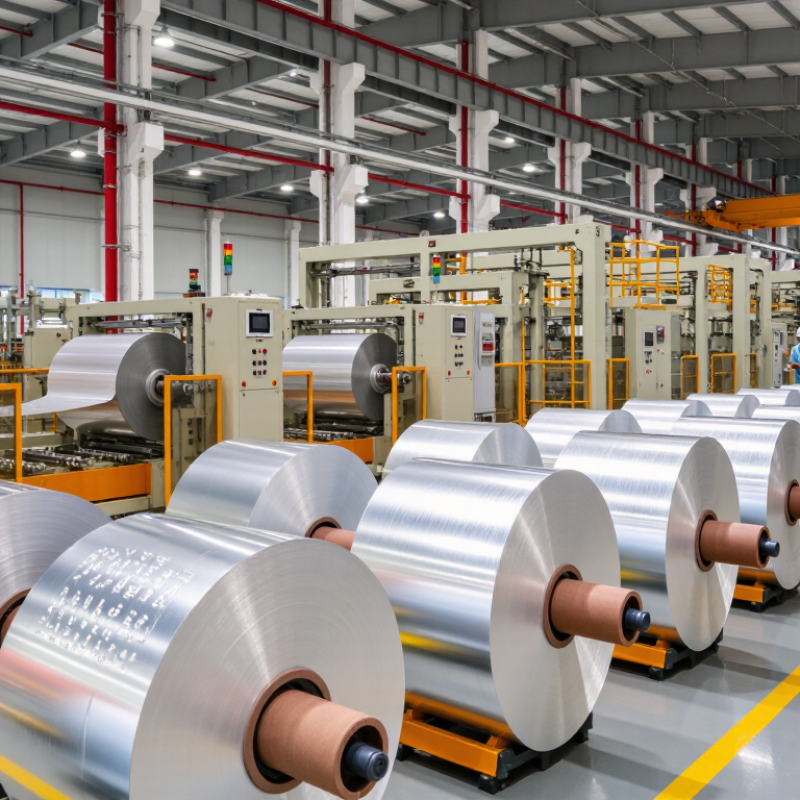
Wrapping foil is a thin metal foil used to protect food, medicine, household products, and other sensitive goods. It can block light, moisture, oxygen, odors, and external contamination. Its performance depends on alloy, thickness, temper, surface finish, and coating quality.
Manufacturer selection matters because small production differences can cause serious packaging problems. Foil that tears during folding may slow filling lines. Uneven thickness can create weak seals. Poor surface treatment may affect printing or lamination. Experienced suppliers control rolling, annealing, slitting, and inspection at each stage. They should provide clear specifications, batch records, test reports, and samples before large orders.
Ask practical questions. Can the supplier maintain stable thickness across long coils? How are pinholes detected? What packaging protects foil during ocean transport?
Does the team understand your forming, sealing, and storage conditions? A reliable manufacturer gives direct answers and accepts reasonable testing. Not every factory is flawless. I have seen suppliers with excellent machinery but weak communication, and others with good service but inconsistent tolerances. That gap deserves attention.
Buyers should compare total value, not only price. Check production capacity, quality controls, response time, export experience, and handling of complaints. A sample may look perfect. Production can differ. Independent inspection and a small trial order remain sensible safeguards for global buyers.
Choosing among China’s top ten wrapping foil manufacturers requires more than comparing quotations. A reliable buyer should examine alloy, temper, thickness tolerance, roll width, and packaging conditions. The International Aluminium Institute reported that China produced about 41.5 million tonnes of primary aluminium in 2023. This capacity supports strong supply, but it does not guarantee consistent foil quality.
Request recent inspection records, not only certificates. ISO 9001 helps, but production evidence matters more. Ask for pinhole counts, tensile strength, elongation, and thickness data from several batches. For food-contact wrapping foil, verify migration testing and declarations against the destination market’s requirements. ASTM F2029 identifies heat-sealing methods for flexible packaging, although it is not a complete foil qualification standard. That distinction is easy to miss.
Check the factory floor personally or through an independent auditor. Observe slitters, annealing furnaces, clean storage, and moisture protection around finished rolls. A good supplier should provide traceable coil numbers and retain samples. Grand View Research estimated the global aluminium foil market at over USD 25 billion in 2023, reflecting strong demand but also intense price pressure. Very cheap offers deserve careful questions. I would compare total delivered cost, defect rates, lead time, and claim handling. One weakness remains: online factory profiles may show outdated equipment. A current video call is useful, but an on-site audit is better.
| No. | Evaluation Dimension | What Global Buyers Should Verify | Common Technical or Commercial Benchmark | Main Buyer Risk |
|---|---|---|---|---|
| 1 | Alloy and Temper | Review the mill test certificate, chemical composition, mechanical properties, and temper designation for every production lot. | Common wrapping-foil options include aluminum alloys such as 8011, 1235, and 3003, with tempers such as H18, H22, or H24 depending on the application. | Incorrect alloy or temper can cause tearing, poor folding, or inadequate strength. |
| 2 | Thickness Capability | Ask for actual thickness tolerance data measured across the web and along the coil, not only the nominal thickness. | Typical wrapping-foil orders may use approximately 0.006–0.030 mm foil, while the required tolerance depends on the agreed specification and applicable standard. | Thickness variation may reduce barrier performance and create problems during high-speed converting. |
| 3 | Width and Slitting Accuracy | Confirm maximum master-coil width, slit-width range, edge quality, burr limits, and width tolerance. | Industrial aluminum foil lines commonly support a wide range of master and slit widths; the purchase contract should state exact finished width and tolerance. | Incorrect width or excessive edge burrs can increase waste and damage packaging equipment. |
| 4 | Surface Cleanliness | Check inspection procedures for oil residue, black spots, foreign particles, pinholes, scratches, and stains. | The foil should have a clean, uniform surface with defect limits defined by an approved sample, inspection plan, or written specification. | Surface contamination may affect printing, lamination, sealing, appearance, and food-contact suitability. |
| 5 | Pinholes and Barrier Quality | Request pinhole inspection records and define the inspection method, sampling plan, and maximum permitted defect level. | For barrier-sensitive packaging, buyers should require documented pinhole control and lot-based inspection rather than relying on visual claims alone. | Pinhole defects can allow moisture, oxygen, light, or odor transfer through the packaging. |
| 6 | Food-Contact Compliance | Verify current declarations, test reports, and compliance documentation for the destination market and intended food-contact use. | Documentation may need to address the relevant requirements of the importing country or region, such as food-contact rules, restricted substances, and migration testing where applicable. | Incomplete or outdated documentation can delay customs clearance and customer approval. |
| 7 | Core, Coil, and Packaging Control | Confirm core diameter, core material, coil outside diameter, maximum coil weight, winding direction, moisture protection, and pallet requirements. | Common industrial core sizes include approximately 76 mm and 152 mm, but the final requirement must match the buyer’s unwinding and converting equipment. | Poor winding or unsuitable cores may cause telescoping, coil collapse, wrinkles, or line stoppages. |
| 8 | Quality Management and Traceability | Audit the quality system, calibration records, nonconformance process, retention samples, and lot traceability from ingot or coil to shipment. | A reliable supplier should provide identifiable lot numbers, inspection records, certificates, and a documented corrective-action process. | Weak traceability makes complaint investigation and product recall more difficult. |
| 9 | Sampling and Pre-Shipment Inspection | Approve a representative production sample and define inspection points for dimensions, appearance, weight, packaging, and documentation before shipment. | Use written acceptance criteria, retained samples, and an agreed inspection standard; independent pre-shipment inspection can be added for high-value orders. | A sample that is not representative of mass production may hide lot-to-lot variation. |
| 10 | Export Reliability and Total Cost | Compare lead time, minimum order quantity, production capacity, payment terms, shipping documents, packaging costs, and after-sales response. | The lowest unit price is not necessarily the lowest landed cost; include freight, inspection, wastage, import charges, claims, and delivery reliability. | Unclear commercial terms or unstable delivery can increase inventory costs and disrupt production planning. |
China’s Top 10 Wrapping Foil Manufacturers for Global Buyers should be assessed by evidence, not website claims. The global aluminium foil market was valued at about USD 25 billion in 2023, according to Fortune Business Insights. Packaging remains a major demand driver. China also produced more than half of the world’s primary aluminium in recent years, based on International Aluminium Institute data.
A practical top-ten shortlist should examine foil thickness, alloy consistency, pinhole control, surface cleanliness, and export experience. Buyers should request mill certificates, recent inspection records, and production samples. A roll should unwind smoothly, without edge cracks or loose telescoping. Small details matter. Packaging should protect against moisture during long sea freight. Suppliers with slitting, annealing, printing, and customized packing capabilities may reduce coordination risks.
Market reports often predict strong growth from food delivery, household storage, and pharmaceutical packaging. However, forecasts can differ because definitions vary between wrapping foil, household foil, and broader flexible packaging. That weakness deserves attention. My ranking would also compare minimum order quantities, lead times, complaint handling, and third-party audits. A low quotation is not automatically competitive. Buyers should test sample rolls under actual folding and sealing conditions before approving a long-term order. Performance can change between batches. This is why transparent data, responsive communication, and traceable production records remain more reliable than promotional rankings.
Representative wrapping-foil thickness ranges commonly specified for major food, pharmaceutical, tobacco, and consumer-packaging applications. Thickness is shown in millimetres and should be confirmed against each supplier’s technical datasheet.
Buyer note: Alloy, temper, pinhole level, coating, lamination structure, roll width, tolerances, and regulatory compliance are also important when comparing Chinese wrapping-foil suppliers. Ranges reflect commonly specified commercial packaging formats and reference practices used in standards such as EN 546 and ASTM B479.
China Top 10 Wrapping Foil Manufacturers for Global Buyers?
The leading manufacturers differ more by capability than by production scale. Some focus on household wrapping foil, offering common widths, embossed surfaces, and easy-tear cartons. Others produce heavier foil for foodservice, insulation, or industrial packaging. Buyers should compare alloy grades, thickness tolerance, roll length, and edge quality. A sample roll reveals more than a polished brochure.
Production flexibility separates many suppliers. Strong manufacturers can adjust foil thickness, slit widths, core sizes, and carton designs for different markets. Their lines may include casting, rolling, annealing, cleaning, slitting, and automated packing. This matters when a buyer needs stable output across several container shipments. Still, larger equipment does not always mean better service.
Reliable suppliers provide batch records, inspection reports, and clear traceability from coil to finished roll. They should explain food-contact controls, surface cleanliness, pinhole testing, and moisture protection during export. Experienced buyers also review response times, replacement policies, and loading photographs. A factory may pass one audit and still struggle with urgent changes. That weakness deserves attention. Smaller manufacturers can sometimes offer closer communication, but their capacity may vary during peak seasons. The best comparison is practical: match product consistency, customization, documentation, and delivery control with the buyer’s actual purchasing risks.
China remains a major sourcing base for wrapping foil, supported by large aluminum-processing capacity and export infrastructure. Grand View Research estimates the global aluminum foil market exceeded USD 27 billion in 2023, with packaging as a major application. Smithers also forecasts continued growth in flexible packaging through 2028. Demand is real. So are the risks.
Choose suppliers through evidence, not attractive catalog photos. Request production samples, thickness reports, alloy details, and certificates for intended food-contact use. Check pinholes, edge cracks, surface cleanliness, roll hardness, and winding consistency. A practical order should state width tolerance, core size, length, packaging method, inspection rules, and replacement terms. Ask whether testing is performed in-house or by an independent laboratory. Verify the factory address and export history through reliable records. Video calls help, but they are not proof.
Tips: Compare at least three quotations with identical specifications. Use a pre-shipment inspection for the first order. Keep a sealed reference sample. Confirm Incoterms and insurance in writing. Do not pay the full balance before quality approval. A lower price may hide thinner foil, unstable coating, or excessive scrap. I have seen specifications become vague during negotiation; that is a warning sign. Even experienced buyers sometimes overlook the inner core diameter. Small details can stop an entire packaging line.